Ireland home prices rise 5.5% as supply shortages persist
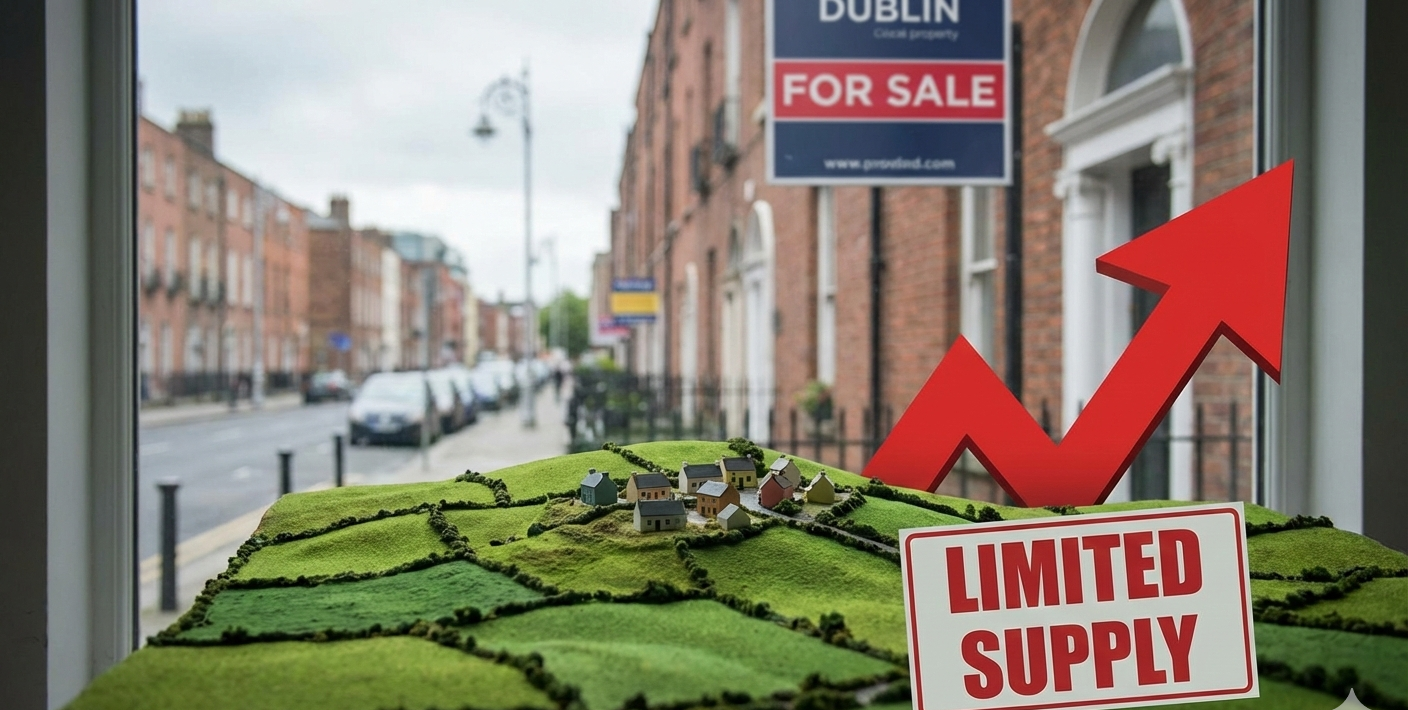
Ireland’s housing market extended its long-running price rally in 2025, with home values rising 5.5% nationwide as limited supply continued to outweigh demand.
By Jennifer Williams • 1/6/2026
Ireland’s housing market remained under upward pressure in 2025, with prices rising for a twelfth consecutive year as limited housing supply continued to constrain buyers.
Nationally, the average asking price for a three-bedroom semi-detached home ended the year just above €423,000, representing a 5.5% increase compared with 2024. While this marked a slower pace than the 6.8% rise recorded the previous year, prices are now 41% higher than pre-pandemic levels and sit just 10% below the peak of the Celtic Tiger era.
Transaction prices outpace listings
Data drawn from the Property Price Register, matched with Daft.ie listings, suggests that actual sale prices rose even faster than advertised figures. Transaction prices increased by 7.4% in 2025, highlighting the competitive nature of the market.
The gap between initial asking prices and final sale prices has also continued to widen. By the end of 2025, homes were selling for an average of 6.6% above their list price, reflecting strong demand and frequent bidding pressure.
Regional Differences in Price Growth
Price increases varied significantly across regions, with markets outside Dublin seeing the strongest gains.
- Dublin, the country’s most expensive market, recorded the slowest growth, with average prices rising 3.1% to €611,000
- Other cities posted a 4.5% increase to €390,000
- Leinster (excluding Dublin) saw prices climb 7.3% to €363,000
- Munster (excluding cities) recorded a 5.7% rise to €300,000
- Connacht-Ulster (excluding Galway) experienced the sharpest increase, up 11.6% to €246,000
The divergence suggests affordability constraints in Dublin may be pushing demand into regional markets, where supply is even more limited.
Supply remains the core challenge
Despite a modest year-on-year improvement, housing supply remains well below historical norms. As of December 1, there were 11,551 second-hand homes listed for sale nationwide. While this represented a 7% increase from the previous year, it remains less than half of the 2015–2019 average of 26,000 homes.
Shortages are particularly severe outside the capital. Availability in regional markets is 63% below late-2010s levels, compared with a 16% shortfall in Dublin, intensifying competition among buyers.
Economists warn of structural imbalance
Ronan Lyons, Professor of Economics at Trinity College Dublin and author of the report, said the data shows demand continuing to outstrip supply across both asking and transaction prices.
“The modest slowdown in price growth is welcome,” Lyons said, “but since the pandemic, the number of homes available to buy has remained much lower than before, putting sustained pressure on buyers.”
He added that resolving Ireland’s housing crisis will require a significant increase in construction activity.
“A country that is building between 30,000 and 35,000 homes a year needs to at least double that number across owner-occupied, social, and rental housing,” Lyons said. “Housing should reflect society, rather than forcing society to adapt to limited stock.”
Outlook for 2026
While price growth has eased slightly, the underlying imbalance between supply and demand suggests continued pressure in 2026 unless construction accelerates meaningfully. With affordability stretched and availability constrained, analysts expect competition for homes to remain intense, particularly in regional markets where supply shortages are most pronounced.
For buyers and policymakers alike, the data underscores a familiar conclusion: without a substantial and sustained increase in housing supply, Ireland’s long-running property price cycle is unlikely to break.
Tags:
Ireland housingreal estatehousingproperty prices