India and EU seal ‘Mother of All Trade Deals’ in landmark shift for Global Commerce
India and the European Union have agreed on a sweeping free trade pact after nearly 20 years of negotiations, unlocking one of the world’s largest trade corridors as both sides seek economic resilience amid rising US trade tensions.
By Sarah Johnson • 1/27/2026
India and the European Union have announced a landmark free trade agreement that reshapes one of the world’s most consequential economic relationships, bringing together nearly a quarter of global GDP and a combined market of two billion people.
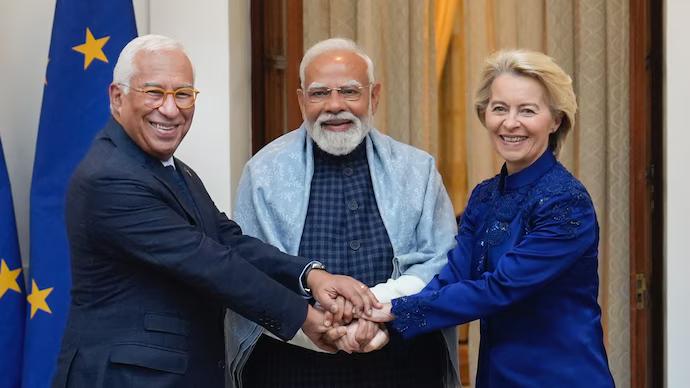
The agreement, concluded after almost two decades of stalled and revived negotiations, was unveiled in New Delhi following a bilateral summit between Indian Prime Minister Narendra Modi, European Commission President Ursula von der Leyen, and European Council President António Costa.
“We delivered the mother of all deals,” von der Leyen said, calling the pact a defining moment for global trade cooperation. Modi described it as “historic” and India’s largest free trade agreement to date.
A deal that redraws trade flows
At its core, the agreement establishes free trade in goods between the EU’s 27 member states and the world’s most populous country. It delivers deep tariff reductions across manufacturing, agriculture, and services while laying the foundation for stronger investment and supply-chain integration.
Under the pact, the EU will phase out tariffs on most exports of chemicals, machinery, electrical equipment, aircraft, and spacecraft. One of the most commercially significant concessions involves motor vehicles: India will slash import duties from as high as 110 percent to 10 percent under a quota of 250,000 vehicles. That quota is six times larger than the one India granted the UK under its 2025 trade agreement.
India will also reduce tariffs on European wine, beer, and olive oil, opening its market further to EU agri-food producers.
What India Gains
Delhi said nearly all Indian exports will receive preferential access to the EU market. Labour-intensive sectors such as textiles, leather, marine products, handicrafts, gems, and jewellery are expected to benefit from reduced or eliminated tariffs.
Agricultural exports including tea, coffee, spices, and processed foods are also set for improved access, although India has shielded politically sensitive sectors such as dairy, cereals, poultry, soy meal, and selected fruits and vegetables.
The agreement also includes a mobility framework that eases short-term travel for professionals, enabling smoother movement of skilled workers and corporate executives between India and Europe.
“This agreement will make access to European markets easier for India’s farmers and small businesses,” Modi said. “It will boost manufacturing, services, and innovative partnerships.”
Geopolitics Driving Economics
The timing of the deal reflects shifting global trade dynamics, particularly pressure from the United States. India has been grappling with 50 percent tariffs imposed by President Donald Trump last year, while EU–US trade relations have recently been strained by tariff threats linked to geopolitical disputes.
Without directly naming Washington, European leaders framed the agreement as a statement in favour of cooperation over confrontation. Costa said the pact sends “an important political message” that India and the EU “believe more in trade agreements than in tariffs.”
Von der Leyen described the deal as a “win-win partnership” between two global economic giants, arguing that collaboration remains the most effective response to global instability.
Winners, Risks, and Compliance Challenges
Economists say the deal could provide critical relief to Indian export sectors hit by US tariffs, particularly shrimp farming, textiles, and jewellery manufacturing. However, analysts also warn of compliance challenges.
The EU’s strict environmental, labour, and carbon regulations could pose hurdles for Indian manufacturers. Economist Mitali Nikore noted that India’s manufacturing base may need rapid adaptation to meet EU standards, particularly around environmental compliance and carbon-border mechanisms.
For European firms, the deal offers long-term access to a fast-growing consumer market and deeper integration into South Asian supply chains. Germany and France are expected to be among the biggest beneficiaries, even though the agreement stops short of the most ambitious trade liberalisation initially envisioned.
Beyond Trade: Security and Strategy
Alongside the trade pact, India and the EU are advancing talks on security, defence cooperation, and climate action. India’s Defence Minister Rajnath Singh confirmed discussions with EU officials on integrating defence supply chains, maritime security, cyber threats, and future defence capabilities.
Drafts are underway for a formal security and defence partnership, signalling that the relationship is expanding beyond economics into strategic alignment.
The agreement will undergo legal finalisation and must be approved by the European Parliament and EU member states before formal signing later this year. While recent EU trade deals have faced political resistance, analysts say the India pact is less controversial due to careful balancing of sensitive sectors on both sides.
Once ratified, the agreement will stand as a cornerstone of India’s expanding trade network, following recent deals with the UK, Australia, Oman, New Zealand, and the European Free Trade Association bloc.
For both India and the EU, the pact is not just a trade agreement but a strategic hedge in an increasingly fragmented global economy.
Tags:
India European Union Free trade agreement Global tradeTariffs